


Page 22 - Tom Steyer Issue
P. 22
Chris Bocachica
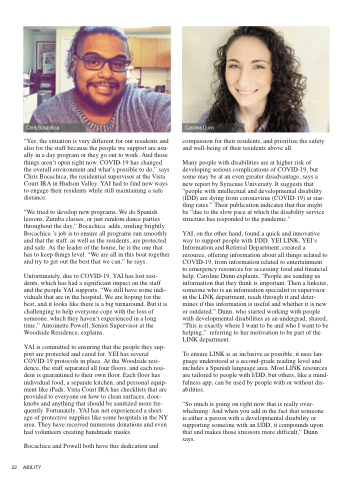
“Yes, the situation is very different for our residents and also for the staff because the people we support are usu- ally in a day program or they go out to work. And those things aren’t open right now. COVID-19 has changed the overall environment and what’s possible to do,” says Chris Bocachica, the residential supervisor at the Vista Court IRA in Hudson Valley. YAI had to find new ways to engage their residents while still maintaining a safe distance.
“We tried to develop new programs. We do Spanish lessons, Zumba classes, or just random dance parties throughout the day,” Bocachica adds, smiling brightly. Bocachica ’s job is to ensure all programs run smoothly and that the staff, as well as the residents, are protected and safe. As the leader of the house, he is the one that has to keep things level. “We are all in this boat together and try to get out the best that we can,” he says.
Unfortunately, due to COVID-19, YAI has lost resi- dents, which has had a significant impact on the staff and the people YAI supports. “We still have some indi- viduals that are in the hospital. We are hoping for the best, and it looks like there is a big turnaround. But it is challenging to help everyone cope with the loss of someone, which they haven’t experienced in a long time,” Antoinette Powell, Senior Supervisor at the Woodside Residence, explains.
YAI is committed to ensuring that the people they sup- port are protected and cared for. YEI has several COVID-19 protocols in place. At the Woodside resi- dence, the staff separated all four floors, and each resi- dent is quarantined to their own floor. Each floor has individual food, a separate kitchen, and personal equip- ment like iPads. Vista Court IRA has checklists that are provided to everyone on how to clean surfaces, door- knobs and anything that should be sanitized more fre- quently. Fortunately, YAI has not experienced a short- age of protective supplies like some hospitals in the NY area. They have received numerous donations and even had volunteers creating handmade masks.
Bocachica and Powell both have this dedication and
Caroline Dunn
compassion for their residents, and prioritize the safety and well-being of their residents above all.
Many people with disabilities are at higher risk of developing serious complications of COVID-19, but some may be at an even greater disadvantage, says a new report by Syracuse University. It suggests that “people with intellectual and developmental disability (IDD) are dying from coronavirus (COVID-19) at star- tling rates.” Their publication indicates that this might be “due to the slow pace at which the disability service structure has responded to the pandemic.”
YAI, on the other hand, found a quick and innovative way to support people with I/DD. YEI LINK, YEI’s Information and Referral Department, created a resource, offering information about all things related to COVID-19, from information related to entertainment to emergency resources for accessing food and financial help. Caroline Dunn explains, “People are sending us information that they think is important. Then a linkster, someone who is an information specialist or supervisor in the LINK department, reads through it and deter- mines if this information is useful and whether it is new or outdated.” Dunn, who started working with people with developmental disabilities as an undergrad, shared, “This is exactly where I want to be and who I want to be helping,” referring to her motivation to be part of the LINK department.
To ensure LINK is as inclusive as possible, it uses lan- guage understood at a second-grade reading level and includes a Spanish language area. Most LINK resources are tailored to people with I/DD, but others, like a mind- fulness app, can be used by people with or without dis- abilities.
“So much is going on right now that is really over- whelming. And when you add in the fact that someone is either a person with a developmental disability or supporting someone with an I/DD, it compounds upon that and makes those stressors more difficult,” Dunn says.
22 ABILITY


