


Page 44 - Tom Steyer Issue
P. 44
letes, to the athletes from the 2002 team,” Brandt said. “They were ignored back then, and they continue to be ignored because people are unaware of their story.”
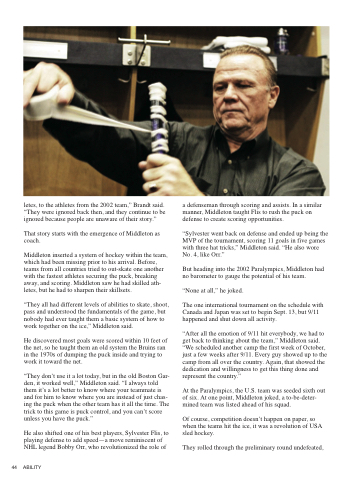
That story starts with the emergence of Middleton as coach.
Middleton inserted a system of hockey within the team, which had been missing prior to his arrival. Before, teams from all countries tried to out-skate one another with the fastest athletes securing the puck, breaking away, and scoring. Middleton saw he had skilled ath- letes, but he had to sharpen their skillsets.
“They all had different levels of abilities to skate, shoot, pass and understood the fundamentals of the game, but nobody had ever taught them a basic system of how to work together on the ice,” Middleton said.
He discovered most goals were scored within 10 feet of the net, so he taught them an old system the Bruins ran in the 1970s of dumping the puck inside and trying to work it toward the net.
“They don’t use it a lot today, but in the old Boston Gar- den, it worked well,” Middleton said. “I always told them it’s a lot better to know where your teammate is and for him to know where you are instead of just chas- ing the puck when the other team has it all the time. The trick to this game is puck control, and you can’t score unless you have the puck.”
He also shifted one of his best players, Sylvester Flis, to playing defense to add speed—a move reminiscent of NHL legend Bobby Orr, who revolutionized the role of
a defenseman through scoring and assists. In a similar manner, Middleton taught Flis to rush the puck on defense to create scoring opportunities.
“Sylvester went back on defense and ended up being the MVP of the tournament, scoring 11 goals in five games with three hat tricks,” Middleton said. “He also wore No. 4, like Orr.”
But heading into the 2002 Paralympics, Middleton had no barometer to gauge the potential of his team.
“None at all,” he joked.
The one international tournament on the schedule with Canada and Japan was set to begin Sept. 13, but 9/11 happened and shut down all activity.
“After all the emotion of 9/11 hit everybody, we had to get back to thinking about the team,” Middleton said. “We scheduled another camp the first week of October, just a few weeks after 9/11. Every guy showed up to the camp from all over the country. Again, that showed the dedication and willingness to get this thing done and represent the country.”
At the Paralympics, the U.S. team was seeded sixth out of six. At one point, Middleton joked, a to-be-deter- mined team was listed ahead of his squad.
Of course, competition doesn’t happen on paper, so when the teams hit the ice, it was a revolution of USA sled hockey.
They rolled through the preliminary round undefeated,
44 ABILITY


