


Page 56 - Tom Steyer Issue
P. 56
56 ABILITY
change contrast, text size, and more.
PBS also works with CAST, Indiana University Institute on Disability and Community, Harvard School of Edu- cation, and the Northeastern University. Cooperating with diverse advisors and partners and asking their tar- get audience, children with and without disabilities, helps PBS accommodate more children and identify access barriers compared to other broadcasters.
“When we started testing the Slidea-ma-zoo game with kids with visual impairments, we started to realize that we didn’t have enough contrast in how the slides were presented, and what the differences were when you put things on the slides. So, we shifted the whole way we looked at the fine elements of the slides to make them more accessible. And if we hadn’t tested this with kids with disabilities, we might have not realized that we weren’t being as accessible as we could be–even just in a basic design,” Sara explains.
Slidea-ma-zoo
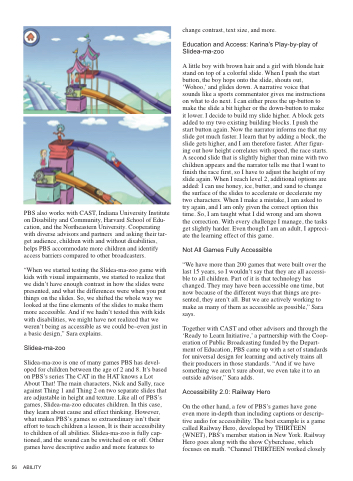
Slidea-ma-zoo is one of many games PBS has devel- oped for children between the age of 2 and 8. It’s based on PBS’s series The CAT in the HAT knows a Lot About That! The main characters, Nick and Sally, race against Thing 1 and Thing 2 on two separate slides that are adjustable in height and texture. Like all of PBS’s games, Slidea-ma-zoo educates children. In this case, they learn about cause and effect thinking. However, what makes PBS’s games so extraordinary isn’t their effort to teach children a lesson, It is their accessibility to children of all abilities. Slidea-ma-zoo is fully cap- tioned, and the sound can be switched on or off. Other games have descriptive audio and more features to
Education and Access: Karina’s Play-by-play of Slidea-ma-zoo
A little boy with brown hair and a girl with blonde hair stand on top of a colorful slide. When I push the start button, the boy hops onto the slide, shouts out, ‘Wohoo,’ and glides down. A narrative voice that sounds like a sports commentator gives me instructions on what to do next. I can either press the up-button to make the slide a bit higher or the down-button to make it lower. I decide to build my slide higher. A block gets added to my two existing building blocks. I push the start button again. Now the narrator informs me that my slide got much faster. I learn that by adding a block, the slide gets higher, and I am therefore faster. After figur- ing out how height correlates with speed, the race starts. A second slide that is slightly higher than mine with two children appears and the narrator tells me that I want to finish the race first, so I have to adjust the height of my slide again. When I reach level 2, additional options are added: I can use honey, ice, butter, and sand to change the surface of the slides to accelerate or decelerate my two characters. When I make a mistake, I am asked to try again, and I am only given the correct option this time. So, I am taught what I did wrong and am shown the correction. With every challenge I manage, the tasks get slightly harder. Even though I am an adult, I appreci- ate the learning effect of this game.
Not All Games Fully Accessible
“We have more than 200 games that were built over the last 15 years, so I wouldn’t say that they are all accessi- ble to all children. Part of it is that technology has changed. They may have been accessible one time, but now because of the different ways that things are pre- sented, they aren’t all. But we are actively working to make as many of them as accessible as possible,” Sara says.
Together with CAST and other advisors and through the ‘Ready to Learn Initiative,’ a partnership with the Coop- eration of Public Broadcasting funded by the Depart- ment of Education, PBS came up with a set of standards for universal design for learning and actively trains all their producers in those standards. “And if we have something we aren’t sure about, we even take it to an outside advisor,” Sara adds.
Accessibility 2.0: Railway Hero
On the other hand, a few of PBS’s games have gone even more in-depth than including captions or descrip- tive audio for accessibility. The best example is a game called Railway Hero, developed by THIRTEEN (WNET), PBS’s member station in New York. Railway Hero goes along with the show Cyberchase, which focuses on math. “Channel THIRTEEN worked closely


