


Page 59 - Tom Steyer Issue
P. 59
Molly of Denali
like when agents fix odd problems, which are math problems. I like to solve the problems along with the actors. I wish I could be an agent! I would be Agent Orion, and I would be in charge of the Maintenance Company because they are really busy fixing household objects all of the time,” Ethan says. Another show he enjoys is Super Why because Ethan says it “teaches a lot of vocabulary, and I like it when they jump into books to find out how they can solve problems based on the moral of the story. I love the idea of knowing differ- ent morals.”
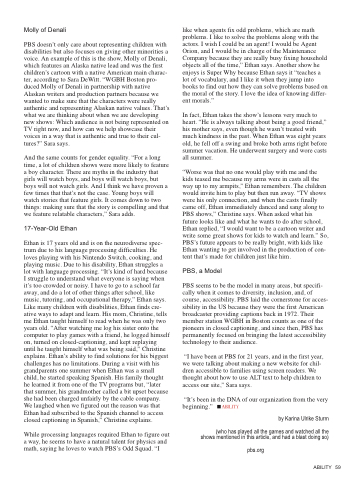
PBS doesn’t only care about representing children with disabilities but also focuses on giving other minorities a voice. An example of this is the show, Molly of Denali, which features an Alaska native lead and was the first children’s cartoon with a native American main charac- ter, according to Sara DeWitt. “WGBH Boston pro- duced Molly of Denali in partnership with native Alaskan writers and production partners because we wanted to make sure that the characters were really authentic and representing Alaskan native values. That’s what we are thinking about when we are developing new shows: Which audience is not being represented on TV right now, and how can we help showcase their voices in a way that is authentic and true to their cul- tures?” Sara says.
In fact, Ethan takes the show’s lessons very much to heart. “He is always talking about being a good friend,” his mother says, even though he wasn’t treated with much kindness in the past. When Ethan was eight years old, he fell off a swing and broke both arms right before summer vacation. He underwent surgery and wore casts all summer.
And the same counts for gender equality. “For a long time, a lot of children shows were more likely to feature a boy character. There are myths in the industry that girls will watch boys, and boys will watch boys, but boys will not watch girls. And I think we have proven a few times that that’s not the case. Young boys will watch stories that feature girls. It comes down to two things: making sure that the story is compelling and that we feature relatable characters,” Sara adds.
“Worse was that no one would play with me and the kids teased me because my arms were in casts all the way up to my armpits,” Ethan remembers. The children would invite him to play but then run away. “TV shows were his only connection, and when the casts finally came off, Ethan immediately danced and sang along to PBS shows,” Christine says. When asked what his future looks like and what he wants to do after school, Ethan replied, “I would want to be a cartoon writer and write some great shows for kids to watch and learn.” So, PBS’s future appears to be really bright, with kids like Ethan wanting to get involved in the production of con- tent that’s made for children just like him.
17-Year-Old Ethan
Ethan is 17 years old and is on the neurodiverse spec- trum due to his language processing difficulties. He loves playing with his Nintendo Switch, cooking, and playing music. Due to his disability, Ethan struggles a lot with language processing. “It’s kind of hard because I struggle to understand what everyone is saying when it’s too crowded or noisy. I have to go to a school far away, and do a lot of other things after school, like music, tutoring, and occupational therapy,” Ethan says. Like many children with disabilities, Ethan finds cre- ative ways to adapt and learn. His mom, Christine, tells me Ethan taught himself to read when he was only two years old. “After watching me log his sister onto the computer to play games with a friend, he logged himself on, turned on closed-captioning, and kept replaying until he taught himself what was being said,” Christine explains. Ethan’s ability to find solutions for his biggest challenges has no limitations. During a visit with his grandparents one summer when Ethan was a small child, he started speaking Spanish. His family thought he learned it from one of the TV programs but, “later that summer, his grandmother called a bit upset because she had been charged unfairly by the cable company. We laughed when we figured out the reason was that Ethan had subscribed to the Spanish channel to access closed captioning in Spanish,” Christine explains.
PBS, a Model
PBS seems to be the model in many areas, but specifi- cally when it comes to diversity, inclusion, and, of course, accessibility. PBS laid the cornerstone for acces- sibility in the US because they were the first American broadcaster providing captions back in 1972. Their member station WGBH in Boston counts as one of the pioneers in closed captioning, and since then, PBS has permanently focused on bringing the latest accessibility technology to their audience.
“I have been at PBS for 21 years, and in the first year, we were talking about making a new website for chil- dren accessible to families using screen readers. We thought about how to use ALT text to help children to access our site,” Sara says.
“It’s been in the DNA of our organization from the very
by Karina Ulrike Sturm
beginning.”
While processing languages required Ethan to figure out a way, he seems to have a natural talent for physics and math, saying he loves to watch PBS’s Odd Squad. “I
(who has played all the games and watched all the shows mentioned in this article, and had a blast doing so)
pbs.org
ABILITY 59


