


Page 58 - Lauren Lolo Spencer Issue
P. 58
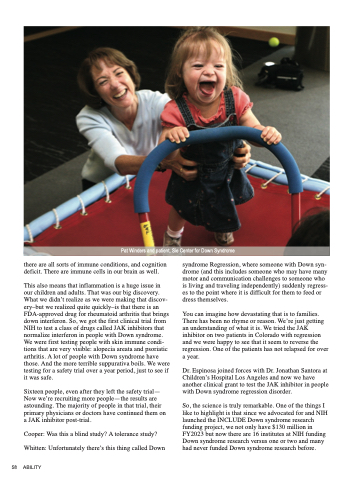
                 Pat Winders and patient, Sie Center for Down Syndrome
  there are all sorts of immune conditions, and cognition deficit. There are immune cells in our brain as well.
This also means that inflammation is a huge issue in our children and adults. That was our big discovery. What we didn’t realize as we were making that discov- ery–but we realized quite quickly–is that there is an FDA-approved drug for rheumatoid arthritis that brings down interferon. So, we got the first clinical trial from NIH to test a class of drugs called JAK inhibitors that normalize interferon in people with Down syndrome. We were first testing people with skin immune condi- tions that are very visible: alopecia areata and psoriatic arthritis. A lot of people with Down syndrome have those. And the more terrible suppurativa boils. We were testing for a safety trial over a year period, just to see if it was safe.
Sixteen people, even after they left the safety trial— Now we’re recruiting more people—the results are astounding. The majority of people in that trial, their primary physicians or doctors have continued them on a JAK inhibitor post-trial.
Cooper: Was this a blind study? A tolerance study? Whitten: Unfortunately there’s this thing called Down
syndrome Regression, where someone with Down syn- drome (and this includes someone who may have many motor and communication challenges to someone who is living and traveling independently) suddenly regress- es to the point where it is difficult for them to feed or dress themselves.
You can imagine how devastating that is to families. There has been no rhyme or reason. We’re just getting an understanding of what it is. We tried the JAK inhibitor on two patients in Colorado with regression and we were happy to see that it seem to reverse the regression. One of the patients has not relapsed for over a year.
Dr. Espinosa joined forces with Dr. Jonathan Santora at Children’s Hospital Los Angeles and now we have another clinical grant to test the JAK inhibitor in people with Down syndrome regression disorder.
So, the science is truly remarkable. One of the things I like to highlight is that since we advocated for and NIH launched the INCLUDE Down syndrome research funding project, we not only have $130 million in FY2023 but now there are 16 institutes at NIH funding Down syndrome research versus one or two and many had never funded Down syndrome research before.
  58 ABILITY


