


Page 60 - Lauren Lolo Spencer Issue
P. 60
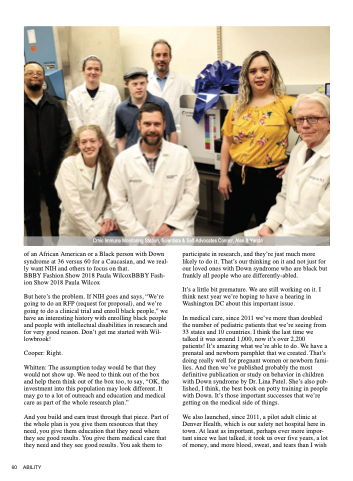
                 Crnic Immune Monitoring Station, Scientists & Self-Advocates Connor, Alan & Yarida
   of an African American or a Black person with Down syndrome at 36 versus 60 for a Caucasian, and we real- ly want NIH and others to focus on that.
BBBY Fashion Show 2018 Paula WilcoxBBBY Fash- ion Show 2018 Paula Wilcox
But here’s the problem. If NIH goes and says, “We’re going to do an RFP (request for proposal), and we’re going to do a clinical trial and enroll black people,” we have an interesting history with enrolling black people and people with intellectual disabilities in research and for very good reason. Don’t get me started with Wil- lowbrook!
Cooper: Right.
Whitten: The assumption today would be that they would not show up. We need to think out of the box and help them think out of the box too, to say, “OK, the investment into this population may look different. It may go to a lot of outreach and education and medical care as part of the whole research plan.”
And you build and earn trust through that piece. Part of the whole plan is you give them resources that they need, you give them education that they need where they see good results. You give them medical care that they need and they see good results. You ask them to
participate in research, and they’re just much more likely to do it. That’s our thinking on it and not just for our loved ones with Down syndrome who are black but frankly all people who are differently-abled.
It’s a little bit premature. We are still working on it. I think next year we’re hoping to have a hearing in Washington DC about this important issue.
In medical care, since 2011 we’ve more than doubled the number of pediatric patients that we’re seeing from 33 states and 10 countries. I think the last time we talked it was around 1,000, now it’s over 2,200 patients! It’s amazing what we’re able to do. We have a prenatal and newborn pamphlet that we created. That’s doing really well for pregnant women or newborn fami- lies. And then we’ve published probably the most definitive publication or study on behavior in children with Down syndrome by Dr. Lina Patel. She’s also pub- lished, I think, the best book on potty training in people with Down. It’s those important successes that we’re getting on the medical side of things.
We also launched, since 2011, a pilot adult clinic at Denver Health, which is our safety net hospital here in town. At least as important, perhaps ever more impor- tant since we last talked, it took us over five years, a lot of money, and more blood, sweat, and tears than I wish
  60 ABILITY


