


Page 62 - Lauren Lolo Spencer Issue
P. 62
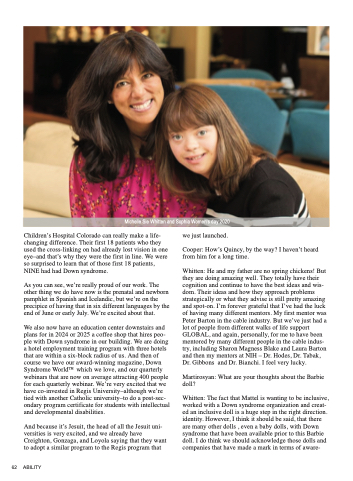
                 Michelle Sie Whitten and Sophia Women's day 2020
  Children’s Hospital Colorado can really make a life- changing difference. Their first 18 patients who they used the cross-linking on had already lost vision in one eye–and that’s why they were the first in line. We were so surprised to learn that of those first 18 patients, NINE had had Down syndrome.
As you can see, we’re really proud of our work. The other thing we do have now is the prenatal and newborn pamphlet in Spanish and Icelandic, but we’re on the precipice of having that in six different languages by the end of June or early July. We’re excited about that.
We also now have an education center downstairs and plans for in 2024 or 2025 a coffee shop that hires peo- ple with Down syndrome in our building. We are doing a hotel employment training program with three hotels that are within a six-block radius of us. And then of course we have our award-winning magazine, Down Syndrome WorldTM which we love, and our quarterly webinars that are now on average attracting 400 people for each quarterly webinar. We’re very excited that we have co-invested in Regis University–although we’re tied with another Catholic university–to do a post-sec- ondary program certificate for students with intellectual and developmental disabilities.
And because it’s Jesuit, the head of all the Jesuit uni- versities is very excited, and we already have Creighton, Gonzaga, and Loyola saying that they want to adopt a similar program to the Regis program that
we just launched.
Cooper: How’s Quincy, by the way? I haven’t heard from him for a long time.
Whitten: He and my father are no spring chickens! But they are doing amazing well. They totally have their cognition and continue to have the best ideas and wis- dom. Their ideas and how they approach problems strategically or what they advise is still pretty amazing and spot-on. I’m forever grateful that I’ve had the luck of having many different mentors. My first mentor was Peter Barton in the cable industry. But we’ve just had a lot of people from different walks of life support GLOBAL, and again, personally, for me to have been mentored by many different people in the cable indus- try, including Sharon Magness Blake and Laura Barton and then my mentors at NIH – Dr. Hodes, Dr. Tabak, Dr. Gibbons and Dr. Bianchi. I feel very lucky.
Martirosyan: What are your thoughts about the Barbie doll?
Whitten: The fact that Mattel is wanting to be inclusive, worked with a Down syndrome organization and creat- ed an inclusive doll is a huge step in the right direction. identity. However, I think it should be said, that there are many other dolls , even a baby dolls, with Down syndrome that have been available prior to this Barbie doll. I do think we should acknowledge those dolls and companies that have made a mark in terms of aware-
  62 ABILITY


