


Page 26 - Peter Farrelly Issue
P. 26
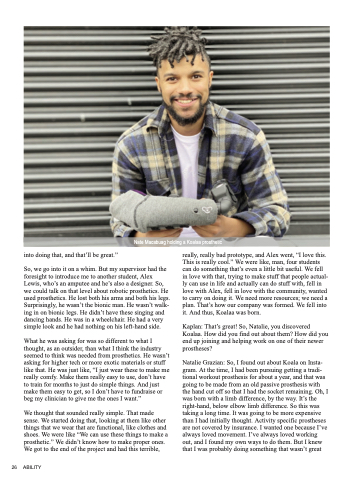
                 Nate Macabuag holding a Koalaa prosthetic
  into doing that, and that’ll be great.”
So, we go into it on a whim. But my supervisor had the foresight to introduce me to another student, Alex Lewis, who’s an amputee and he’s also a designer. So, we could talk on that level about robotic prosthetics. He used prosthetics. He lost both his arms and both his legs. Surprisingly, he wasn’t the bionic man. He wasn’t walk- ing in on bionic legs. He didn’t have these singing and dancing hands. He was in a wheelchair. He had a very simple look and he had nothing on his left-hand side.
What he was asking for was so different to what I thought, as an outsider, than what I think the industry seemed to think was needed from prosthetics. He wasn’t asking for higher tech or more exotic materials or stuff like that. He was just like, “I just wear these to make me really comfy. Make them really easy to use, don’t have to train for months to just do simple things. And just make them easy to get, so I don’t have to fundraise or beg my clinician to give me the ones I want.”
We thought that sounded really simple. That made sense. We started doing that, looking at them like other things that we wear that are functional, like clothes and shoes. We were like “We can use these things to make a prosthetic.” We didn’t know how to make proper ones. We got to the end of the project and had this terrible,
really, really bad prototype, and Alex went, “I love this. This is really cool.” We were like, man, four students can do something that’s even a little bit useful. We fell in love with that, trying to make stuff that people actual- ly can use in life and actually can do stuff with, fell in love with Alex, fell in love with the community, wanted to carry on doing it. We need more resources; we need a plan. That’s how our company was formed. We fell into it. And thus, Koalaa was born.
Kaplan: That’s great! So, Natalie, you discovered Koalaa. How did you find out about them? How did you end up joining and helping work on one of their newer prostheses?
Natalie Grazian: So, I found out about Koala on Insta- gram. At the time, I had been pursuing getting a tradi- tional workout prosthesis for about a year, and that was going to be made from an old passive prosthesis with the hand cut off so that I had the socket remaining. Oh, I was born with a limb difference, by the way. It’s the right-hand, below elbow limb difference. So this was taking a long time. It was going to be more expensive than I had initially thought. Activity specific prostheses are not covered by insurance. I wanted one because I’ve always loved movement. I’ve always loved working out, and I found my own ways to do them. But I knew that I was probably doing something that wasn’t great
26 ABILITY


