


Page 26 - Lauren Lolo Spencer Issue
P. 26
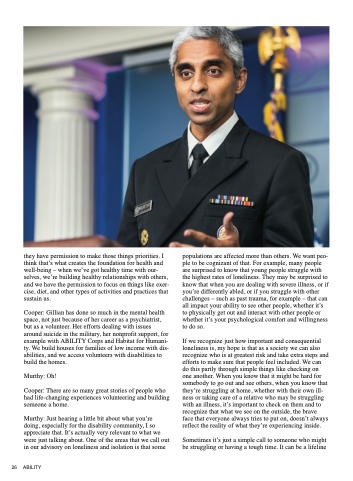
                 they have permission to make those things priorities. I think that’s what creates the foundation for health and well-being – when we’ve got healthy time with our- selves, we’re building healthy relationships with others, and we have the permission to focus on things like exer- cise, diet, and other types of activities and practices that sustain us.
Cooper: Gillian has done so much in the mental health space, not just because of her career as a psychiatrist, but as a volunteer. Her efforts dealing with issues around suicide in the military, her nonprofit support, for example with ABILITY Corps and Habitat for Humani- ty. We build houses for families of low income with dis- abilities, and we access volunteers with disabilities to build the homes.
Murthy: Oh!
Cooper: There are so many great stories of people who had life-changing experiences volunteering and building someone a home.
Murthy: Just hearing a little bit about what you’re doing, especially for the disability community, I so appreciate that. It’s actually very relevant to what we were just talking about. One of the areas that we call out in our advisory on loneliness and isolation is that some
populations are affected more than others. We want peo- ple to be cognizant of that. For example, many people are surprised to know that young people struggle with the highest rates of loneliness. They may be surprised to know that when you are dealing with severe illness, or if you’re differently abled, or if you struggle with other challenges – such as past trauma, for example – that can all impact your ability to see other people, whether it’s to physically get out and interact with other people or whether it’s your psychological comfort and willingness to do so.
If we recognize just how important and consequential loneliness is, my hope is that as a society we can also recognize who is at greatest risk and take extra steps and efforts to make sure that people feel included. We can do this partly through simple things like checking on one another. When you know that it might be hard for somebody to go out and see others, when you know that they’re struggling at home, whether with their own ill- ness or taking care of a relative who may be struggling with an illness, it’s important to check on them and to recognize that what we see on the outside, the brave face that everyone always tries to put on, doesn’t always reflect the reality of what they’re experiencing inside.
Sometimes it’s just a simple call to someone who might be struggling or having a tough time. It can be a lifeline
  26 ABILITY


